“From Bright Leaf to Berkshires” Program Grows Sales, Opportunities for Ex-Tobacco Farmers
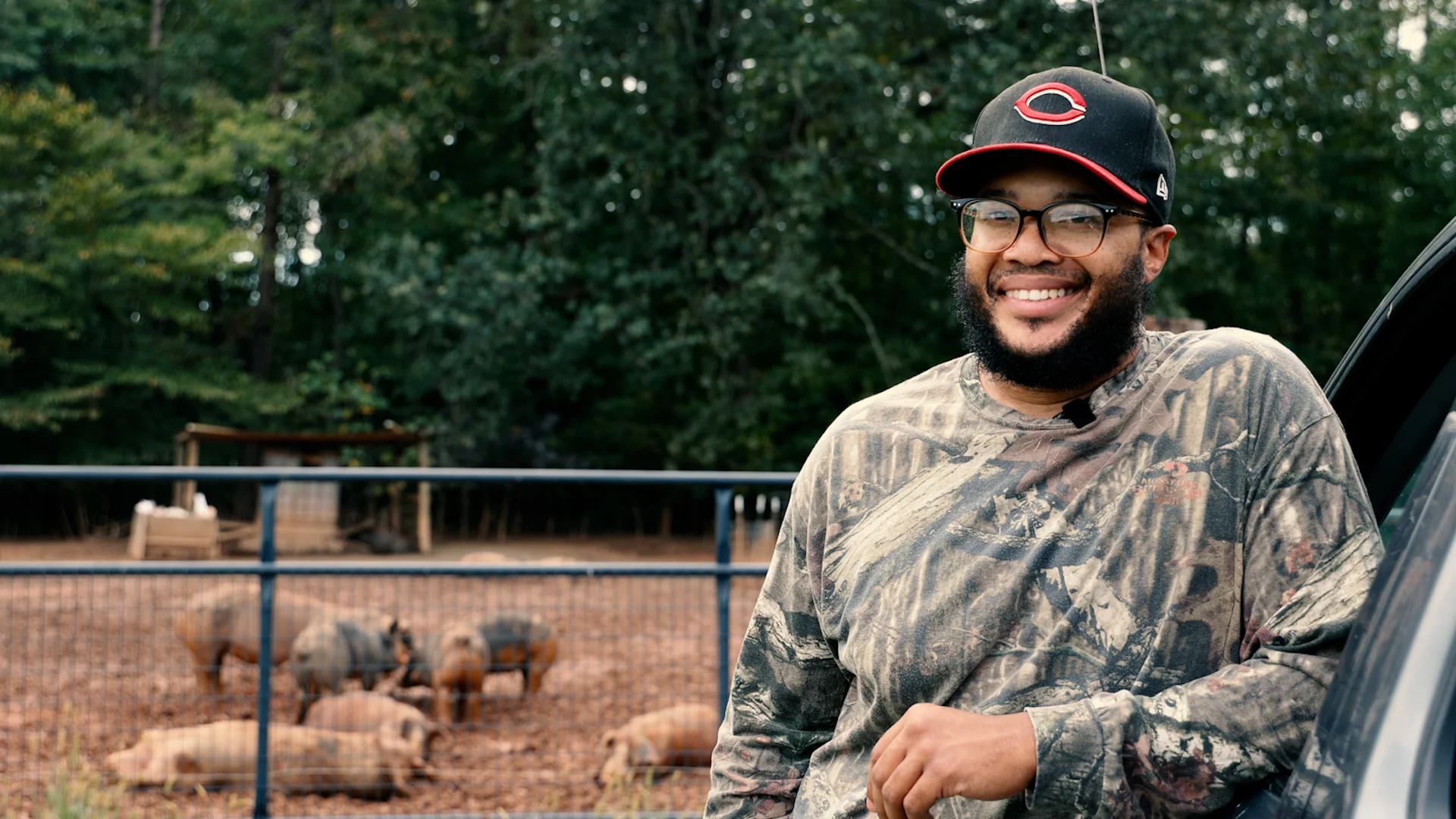
Fourth-generation farmer Brandon Wiley grew up on a tobacco farm, but decided to transition to raising Berkshire hogs using knowledge from a program offered by Cooperative Extension at N.C. A&T.
CASWELL COUNTY — Brandon Wiley, a fourth-generation owner of L.C.W. Farms in Caswell County, saw his family farm take a hit when North Carolina began to shift away from tobacco farming in the 1990s.
“[My family] were big tobacco farmers up until I got into high school,” said Wiley, a 2021 agricultural education graduate of N.C. A&T’s College of Agriculture and Environmental Sciences. “In order to help improve our business, we shifted things over and increased our beef cattle herd. Then, about five or 10 years ago, I built a few chicken houses and got into chickens.”
While those changes improved his family farm’s bottom line, he ultimately found a more lucrative niche opportunity: pork production.

Berkshire hogs, such as these on L.C.W. Farms, are known for their high-quality, heavily marbled meat.
“As we were moving from one (thing) to another, I figured I’d take a stab at hog raising,” Wiley said. “Luckily, I heard about a program offered by Cooperative Extension at N.C. A&T on that topic, and we just jumped in.”
Tobacco farming and North Carolina were once synonymous. For more than three centuries, tobacco was the state’s second-largest agricultural commodity behind soybeans, guaranteeing growers income from predictable markets.
Since the 1990s, however, policy changes, global competition and public health demands have taken the bloom off N.C.’s tobacco market, and from 2002 to 2022, North Carolina witnessed a 90 percent decrease in tobacco farms from 56,977 farms to 2,987, according to the U.S. Department of Agriculture.
That decline has prompted farmers to seek alternatives to maintain profit margins.
The program that Wiley found, “From Bright Leaf to Berkshires,” funded through a grant by the North Carolina Tobacco Trust Fund Commission, allows tobacco farmers financially impacted by policy and social changes to improve their profitability by learning to produce Berkshire pigs using hoop structures, an alternative swine production system.
“We developed the program in 2022 to help farmers transition to a more profitable enterprise, or even supplement their current tobacco operations,” said Derrick Coble, Ph.D., swine specialist at N.C. A&T. “Berkshires are known for their high-quality meat with heavy marbling. They can serve as a niche market opportunity for interested farmers.”
In its first two years, 2023 and 2024, 18 farmers took part in 10 lessons covering everything from basics, such as nutrition and reproduction, to more advanced topics in waste management, welfare and behavior, diseases and marketing methods.
So far, the program has accounted for 25 jobs, $552,500 worth of pork products sold, and more than $22,000 in tax revenue for the state, Coble said. He and his team will monitor the group for the next two years to make sure that all participants are able to be profitable. The social impact has also proven to be important, with farmers deciding to stay in the business and draw support from each other rather than feeling isolated and giving up farming.
According to Coble, all 18 program graduates are actively raising hogs and producing pork products.
The program brought the change that Wiley had been looking for. Since switching to swine production, Wiley said, L.C.W. Farms has increased its net annual profits by 40%, netting $6,800 per acre with Berkshires compared to approximately $4,500 per acre with tobacco.
“Beyond just the raw numbers, the cash flow is way more predictable,” said Wiley. “Tobacco keeps you locked into a rigid, single-harvest season, whereas hogs give us reliable, multi-season turnover.”
The farm currently houses more than 60 Berkshires, including piglets. He has developed relationships with restaurants, specialty meat buyers, and local consumers seeking high- quality pork, including a partnership with Firsthand Foods in Durham, where he sells pigs wholesale for barbecue.
“I’ve learned a tremendous amount: feed quality, feed brands and percentages, things I should be looking for if they’re feeling sick — just a wealth of information,” Wiley said of the program. “Anything you can think of, I’ve been exposed to so I can continue on this hog-growing journey.”